
What decides your price
ABCD Measurement Guide
The four factors that move a pet relocation quote — and how to read them before you compare companies.
Measuring guide
How to measure your pet: A, B, C and D
Crate size — and therefore cost — comes from four measurements, not from your pet's weight. Take them with a tape measure and keep the tape visible in the photograph: that is what lets us confirm the size and the airline's acceptance before anything is booked.
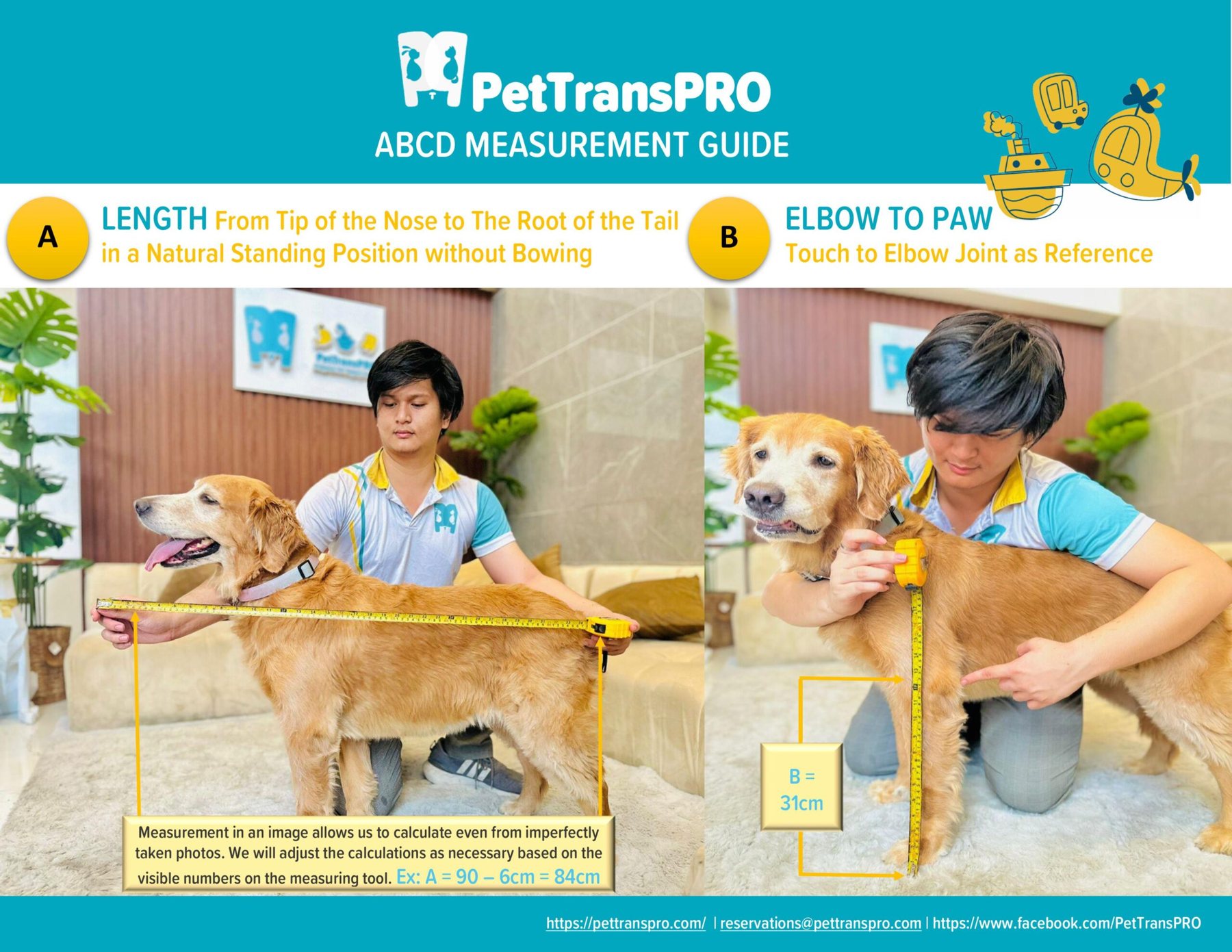
Length
From the tip of the nose to the root of the tail, in a natural standing position without bowing.
Elbow to paw
From the floor to the elbow joint, taken as the reference point for standing height.
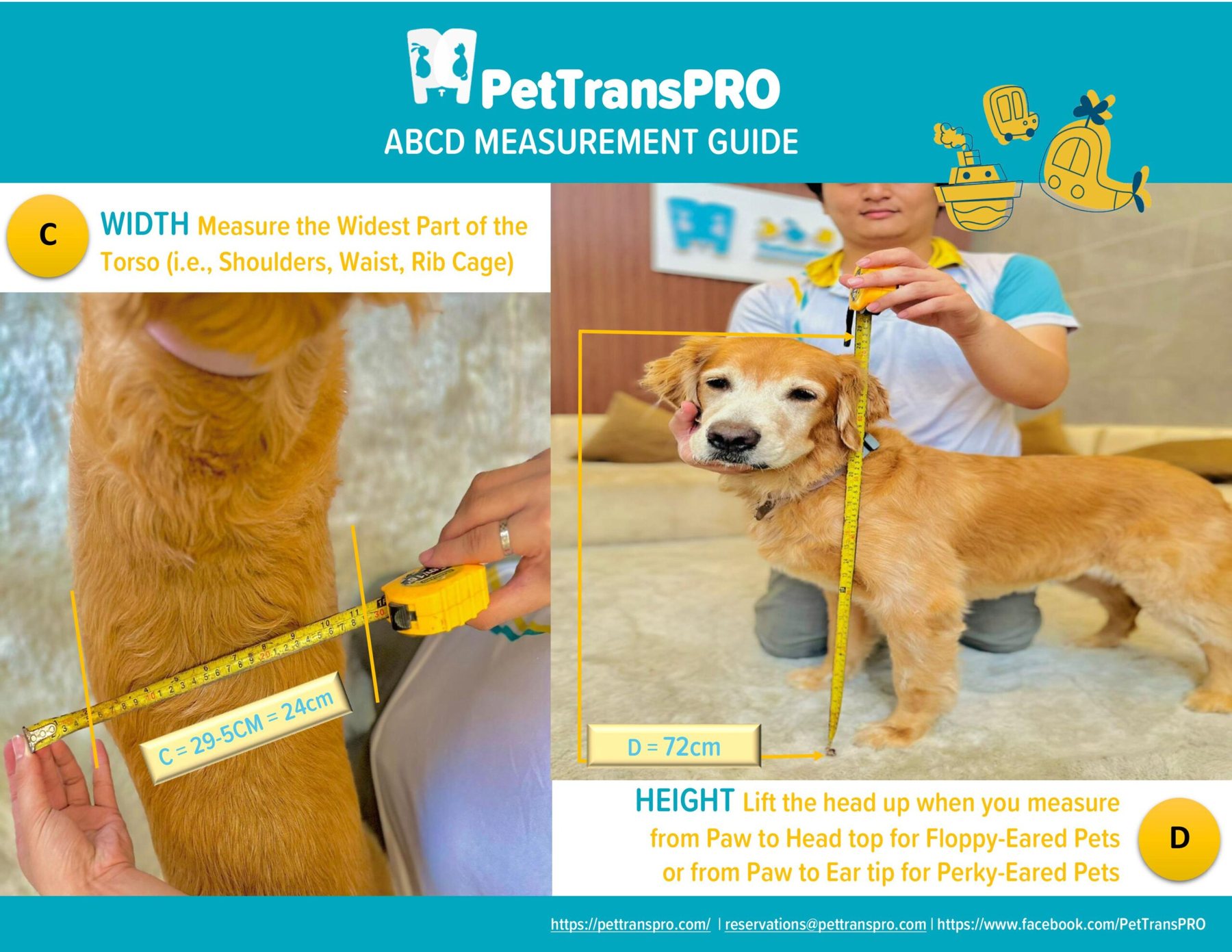
Width
The widest part of the torso — across the shoulders, the waist or the rib cage, whichever is widest.
Height
Lift the head up when you measure. From the paw to the top of the head for floppy-eared pets, or from the paw to the ear tip for perky-eared pets.
A photo is enough to start
Imperfect photos are fine. Because the tape measure is in the frame, we can calculate from the visible numbers and adjust the crate size before we quote — the same way we check every booking by hand.
Crate sizing
Know which crate your pet needs
Take the four ABCD measurements above, enter them in the crate calculator, and it returns the smallest IATA container we stock that fits your pet — with the internal dimensions the airline checks. The final crate always depends on your pet's actual ABCD measurements, which your consultant checks before booking.
Find my crate sizeTo match your pet with the correct travel crate, we use four key measurements: A, B, C, and D .
You can send these to us as numbers or as clear photos with a measuring tape. Our team can still calculate accurately even if the tape is not perfectly lined up, as long as the numbers are visible.
A (Nose to Tail Base) and B (Elbow to Paw)
- To get the correct A or nose to tail base, measure your pet while standing naturally—no stretching or bowing.
Place the measuring tape from the tip of the nose to the start of the tail (where the tail attaches to the body).
This gives us the body length we use when calculating crate size.
- To get the correct B or elbow to paw, find the elbow joint on the front leg.
Measure straight down from that elbow to the top of the paw .
This tells us how much ground clearance and standing comfort your pet needs inside the crate
C (Width) and D (Height)
- To get the correct C (Width), look at your pet from above or in front and find the widest part of the torso.
This could be the shoulders, rib cage or waist.
This measurement is used to ensure that your pet can turn and lie down comfortably inside the crate.
- To get the correct D (Height), gently lift or position the head in a natural looking up position and measure from the floor to the highest point.
For floppy -eared pets , the highest point will be the top of the head .
For perky-eared pets , the highest point will be the tip of the ears .
Check Crate Size
Ready to start?
Send us your pet's origin, destination and travel date. A team of specialists reviews it and replies with the documents, a relocation plan and an itemized quote.